Search

Windows Instrumen­tation Call­backs – Part 4

February 10, 2026

Windows Instrumentation Callbacks – Detection and Counter Meassures, Part 4

Introduction

This multi-part blog series will be discussing an undocumented feature of Windows: instrumentation callbacks (ICs).

If you don’t yet know what ICs are, we strongly recommend you read the first part of this series. If you are curious about what can be done with them, we recommend also reading the second and third part.

In this blog post we will cover ICs from a more theoretical standpoint. Mainly restrictions on unsetting them, how set ICs can be detected and how new ones can be prevented from being set. Spoiler: this is not entirely possible.

Disclaimer

  • This series is aimed towards readers familiar with x86_64 assembly, computer concepts such as the stack and Windows internals. Not every term will be explained in this series.
  • This series is aimed at x64 programs on the Windows versions 10 and 11. Neither older Windows versions nor WoW64 processes will be discussed.

Detection

In the first blog post we reversed NtSetInformationProcess to find out that the PROCESSINFOCLASS enum value 0x28 is used to set an IC. In the kernel the member InstrumentationCallback of the corresponding KPROCESS structure then gets set to the passed callback address. This of course means that a kernel driver could simply check the KPROCESS structure of the process to check if an IC is set. Before we move on to user-mode ways of detecting ICs, let’s cover something we haven’t in any of the previous posts: unregistering ICs.

Unregistering ICs

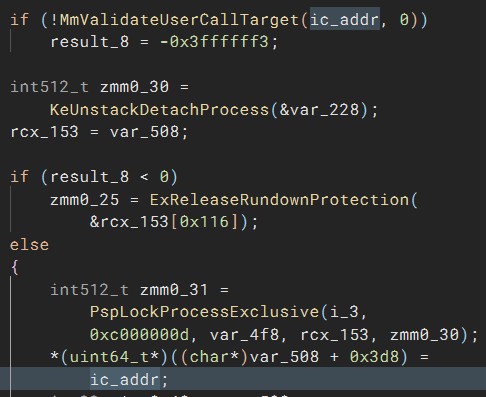
We thought “How hard can it be? We can simply call NtSetInformationProcess with a null pointer to unset it.” Correct… sometimes… if the process uses control flow guard (CFG), your IC would still be set as a null pointer is no valid call target. In the first blog post we already mentioned that ntoskrnl!NtSetInformationProcess+0x1d09 is where the callback address gets set in the KPROCESS structure, so let’s go there in the decompiler. In this case we renamed the relevant stack variable that contains the callback address to “ic_addr”. As can be seen, there is a call to MmValidateUserCallTarget with that address before it gets set in KPROCESS:

Consultant

Category
Date
Navigation

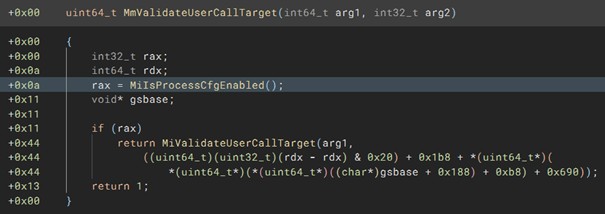
If we decompile MmValidateUserCallTarget, it quickly becomes clear that this has something to do with CFG as can be seen by the call to MiIsProcessCfgEnabled because otherwise simply 1 is returned.

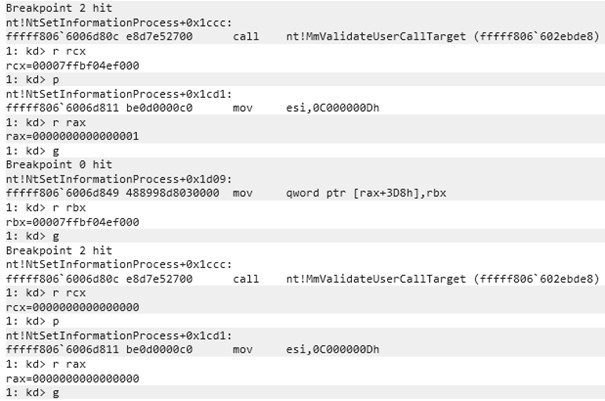
A null pointer is very obviously not a valid call target; however, let’s quickly prove that this function isn’t successful by using a kernel debugger and placing a breakpoint on NtSetInformationProcess+1ccc, which is where MmValidateUserCallTarget is executed. Additionally, we placed a breakpoint on NtSetInformationProcess+1d09 to show where the IC gets set in the KPROCESS struct. As can be seen, when the address for the IC is passed to MmValidateUserCallTarget, the function returns 1 and KPROCESS is updated. However, when a null pointer is passed, 0 is returned.

You can’t see if KPROCESS is updated after the last g instruction; you will just have to believe us that it didn’t. But as can be seen in the previously shown decomplication of NtSetInformationProcess, the relevant code branch to update KPROCESS isn’t even executed, as instead ExRreleaseRundownProtection is called.

This means, an IC can only be entirely unregistered (be set back to 0) if a process doesn’t have CFG enabled. Otherwise, it can only be updated to a new valid call address and never be set back to the original value the InstrumentationCallback member value had at the processes start: 0. While any valid call target’s address can be used, the address should be carefully selected, as most will of course crash the program as random code would be executed. The updated callback of course still needs to do what is expected of an IC, which is to continue execution by jumping to r10. This also means that if a DLL that gets loaded into a CFG-enabled process sets an IC with the callback being in its own memory region, the process will crash once that DLL is unloaded and the DLL’s memory including the callback gets deallocated. In this case the callback would also need to get updated before the DLL is unloaded if the process shouldn’t crash.

For CFG-enabled processes it is thus not possible to hide from kernel mode drivers that an IC was set, as they can simply check if the process’s KPROCESS.InstrumentationCallback != 0. For non-CFG processes the InstrumentationCallback member can be restored to its original value.

In addition to that, enabling CFG makes ICs easier to detect on a big scale, as poorly written IC implementations will crash the process, which will be written to event logs. This is of course not great, but what’s better? Processes crashing, which indicates something weird is going on, or working processes with an attacker’s code inside?

User mode

That it is possible detect if an IC is set from kernel mode was obvious, as we discussed in the first blog part already that it’s merely a member of the process’s KPROCESS structure. Let’s discuss the way more interesting scenario: detecting from user mode if an IC is set on one’s own process. If you step through the process with a debugger, you will obviously be able to tell that an IC is registered if a syscall that is stepped over causes the code flow to magically jump to somewhere else. Let’s discuss different ways.

If an IC is set with NtSetInformationProcess, the logical way of checking if an IC is set would be to call NtQueryInformationProcess instead. However, when we disassemble/decompile NtQueryInformationProcess and search for the switch case on the second parameter, which is the PROCESSINFOCLASS, we can see that it is not implemented. This is shown by the following shortened decompilation:

NtQueryInformationProcess(arg1, proc_info_class, …)
[…]
+0x002b        int64_t proc_info_class_copy = (int64_t)proc_info_class;
[…]
+0x02f9            switch (proc_info_class_copy) {
[…]
+0x3bf6                case 5:
+0x3bf6                case 6:
+0x3bf6                case 8:
+0x3bf6                case 9:
+0x3bf6                case 0xb:
+0x3bf6                case 0xd:
+0x3bf6                case 0x10:
+0x3bf6                case 0x11:
+0x3bf6                case 0x19:
+0x3bf6                case 0x23:
+0x3bf6                case 0x28:
+0x3bf6                case 0x29:
+0x3bf6                case 0x30:
+0x3bf6                case 0x35:
+0x3bf6                case 0x38:
+0x3bf6                case 0x39:
+0x3bf6                case 0x3e:
+0x3bf6                case 0x3f:
+0x3bf6                case 0x44:
+0x3bf6                case 0x4e:
+0x3bf6                case 0x50:
+0x3bf6                case 0x53:
+0x3bf6                case 0x56:
+0x3bf6                case 0x5a:
+0x3bf6                case 0x5b:
+0x3bf6                case 0x5d:
+0x3bf6                case 0x5f:
+0x3bf6                {
+0x3bf6                    result = -0x3ffffffd;
+0x3bf6                    break;
+0x3bf6                }
[…]

As you might remember, we used 0x28 for setting the IC.

This means, we can’t use NtQueryInformationProcess to find out if an IC is set. We don’t know of any user mode function that allows querying for the IC; that does of course not mean that it doesn’t exist. By dumping kernel memory, we could of course again read out the KPROCESS structures to check for ICs, but this would obviously require a driver or some way to execute code in the kernel memory, riiiight Microsoft? There is a way (/are ways?) of dumping kernel memory including the KPROCESS structures entirely from user mode without needing to load any drivers yourself. We won’t tell you how this is done, as we are already spoon-feeding you enough 😉 Additionally, that would be a moral gray area; we want to keep EDRs/ACs a step ahead of attackers.

rcx and r10

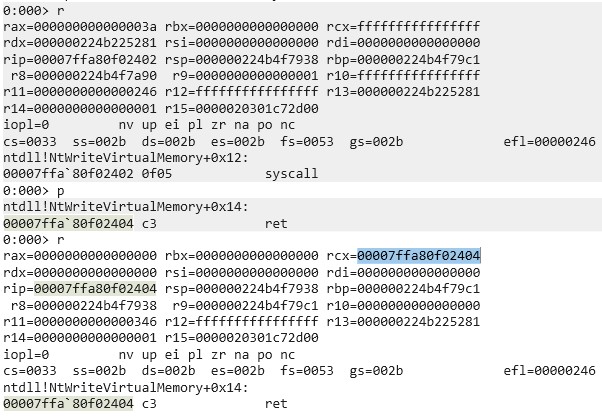
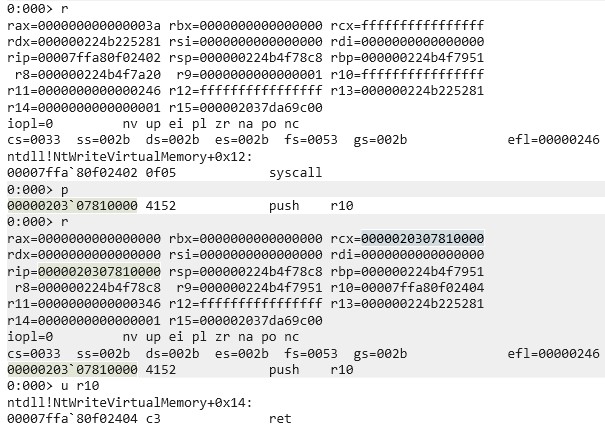
In the first blog post we briefly mentioned that we recommend attaching a debugger to a program with and without an IC set to check the values of registers after syscalls but didn’t dive deeper into it. I attached WinDbg to a random process and set a breakpoint on a random syscall (ntdll!NtWriteVirtualMemory+0x12). As can be seen in the following screenshot, rcx was changed to the address of the instruction after the syscall, that is the ret instruction. Also, r10 was zeroed.

Now compare this to the following screenshot, which was taken after an IC was set:

As expected, r10 contains the address of the actual return address. The picture also shows that rcx contains the address of the start of the IC instead of the actual return address.

This means, we can detect poorly written ICs by checking rcx and r10 at the ret instruction after the syscall, that is the instruction it would normally execute if no IC was set. These registers can of course be arbitrarily changed by the IC, but that needs to be kept in mind by the author. If rcx isn’t properly set, it does not only leak that an IC is set but also where it is located in memory, which could be used to automatically dump it or for something even more interesting ‑ which we will get to.

Preventing ICs from getting set

If it is hard to detect whether an IC is set or not, we could try preventing others from setting them in the first place. This is not very easy to do. Let’s assume two different starting points of an attacker: the attacker is inside the process on which he wants to set an IC or the attacker is in another process. If the attacker is already in the kernel, you got entirely different problems so we will not discuss that.

One’s own process context

In the second part of this blog post, we already discussed one way of preventing the IC from getting overwritten, which was done by hooking NtSetInformationProcess. For a simple attacker this suffices; however, the hook can be avoided through direct and indirect syscalls. Even if the syscall instruction in NtSetInformationProcess is hooked, an attacker could use the syscall instruction of another Windows API to not run into the hook. This would mess up the callstack, but to detect that, a kernel driver would be required as once the syscall was executed and returned to user mode, the new IC is already set. Another idea is to place a page guard on the memory page of NtSetInformationProcess after registering an appropriate exception handler to detect SSN reads of the SSN of NtSetInformationProcess or nearby syscalls; this would however take a toll on performance.

Another detection mechanism is using a heartbeat. The originally set IC could use a counter that increments on every IC execution, while some regular code that is not in the IC checks every few seconds if the counter was incremented. If the counter wasn’t incremented in a while, the IC was overwritten, as syscalls are, depending on the program, constantly made. This way the program could then try reregistering its own IC, which is not guaranteed to succeed, but the program can again detect through the counter if reregistering the IC was successful.

If the attacker’s IC is adjusted to the program, he could of course also increment that counter himself, or even more interesting: if the previous ICs address was leaked through the beforementioned ways, the attacker’s IC could call the previous IC through its own IC while filtering what is passed to it. This means, it is not only interesting for attackers to hide that an IC is set but also for defenders as there’s no proper way of being entirely sure that your IC is the registered one. At this point we are talking about a very sophisticated attacker, as the IC would need to be highly adapted. If the victim process does not repeatedly dump the IC address itself (very unlikely), it has no way of knowing if its own IC was overwritten, as any detection logic in that IC can be automatically executed by calling the IC from the new, actually set IC.

Other process context

As initially mentioned, setting an IC on another process requires the SeDebugPrivilege. This is a very extensive privilege. If the user does not have this privilege, there is no way for him to set an IC on another process. This means, properly hardening your environment and stripping users of unneeded privileges is also the best defense against ICs being set on other processes.

Let’s assume the user has the SeDebugPrivilege. In that case the victim process can’t do much against an IC being set other than repeatedly scanning for open handles and closing those with the PROCESS_SET_INFORMATION access mask. This contains a race condition, as with the correct timing an IC can still be set. Of course, once the IC is set the same detection mechanisms mentioned in “One’s own process context” apply again.

Closing words

This marks the end of this blog series. Congratulations if you read through all of it! If you got questions or built upon this research (as there’s still a lot to discover with ICs), feel free to reach out.

Further blog articles

Reverse Engineering

Windows Instrumen­tation Call­backs – Part 3

January 28, 2026 – In this third part of the blog series, you will learn how to inject shellcode into processes with ICs as an execution mechanism without creating any new threads for your payload and without installing a vectored exception handler.

Author: Lino Facco

Mehr Infos »
Do you want to protect your systems? Feel free to get in touch with us.
Search
Search